How to Make Better Decisions in Full-Time Football Markets
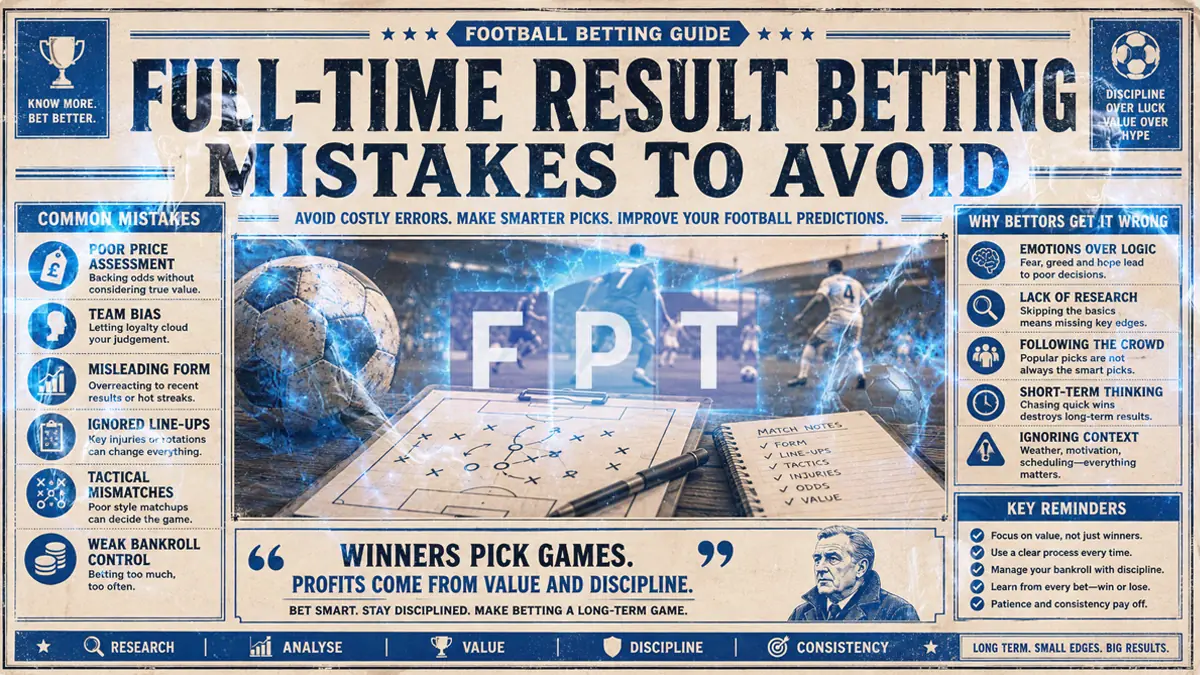
Full-time result betting is one of the most familiar markets in football. Bettors choose between a home win, a draw and an away win, making the market appear simple and accessible. However, that apparent simplicity often encourages rushed decisions. Many unsuccessful bets are not caused by a complete lack of football knowledge. They are caused by poor price assessment, emotional judgement, incomplete research and a failure to recognise how unpredictable a single match can be.
Predicting the correct result requires more than identifying the stronger team. A club may have better players, a higher league position and stronger recent results, yet still represent a poor betting selection at the available odds. The central question is not only which team is most likely to win. It is whether the market price accurately reflects the true probability of that outcome.
A professional approach to full-time result betting combines team performance, tactical compatibility, home and away data, squad availability, motivation, schedule pressure and odds value. It also accepts that some fixtures should be avoided. Understanding the most common mistakes can help bettors become more selective, improve the quality of their analysis and protect their bankroll over the long term.
Backing the Favourite Without Assessing the Price
Blindly supporting favourites is one of the most common full-time result betting mistakes. Bettors are naturally attracted to stronger teams because they appear safer. A famous club playing against a lower-ranked opponent may look like an obvious home win, but bookmakers already understand the difference in quality and reflect it in the odds.
A favourite can be highly likely to win and still offer poor value. If the potential return is too small compared with the possibility of a draw or upset, the selection may not be worth taking. Football contains too many unpredictable events for any result to be considered guaranteed. A red card, missed penalty, defensive error, injury or inspired goalkeeper can change the outcome completely.
Probability Must Come Before Reputation
Bettors should convert odds into implied probability and compare that figure with their own estimate. If a team is priced at 1.50, the market is assigning it an implied probability of approximately 66.7 percent before accounting for the bookmaker margin. The bettor must decide whether the team has a genuinely greater chance of winning than that percentage suggests.
Backing a club simply because it is expected to win is not enough. The price must compensate for the risk. Long-term betting performance depends on finding situations where the available odds are higher than the realistic probability of the outcome, not merely on selecting the most recognisable team.
Relying Too Heavily on League Position
League tables provide useful information, but they are historical summaries rather than complete predictions of future performance. A team in 4th place may be struggling with injuries, fatigue or a difficult schedule. A team in 15th may have improved considerably after changing manager, adjusting its tactical system or recovering important players.
League position can also hide differences in fixture difficulty. One side may have accumulated points against weaker opposition, while another may have faced several title contenders. Comparing positions without considering the schedule can produce an inaccurate picture of current strength.
Current Conditions Can Be More Relevant Than Season Rankings
Full-time result analysis should focus on the conditions surrounding the specific match. Bettors need to examine the current squad, recent performances, tactical matchup and motivation of each team. Season-long rankings remain relevant, but they should support the analysis rather than control it.
This is particularly important near the end of a campaign. A mid-table club with little left to achieve may show less intensity than an opponent fighting relegation or chasing promotion. The league table explains where each team stands, but it does not automatically explain how each team will approach the next fixture.
Misreading Recent Form
Recent form is frequently treated as a list of wins, draws and defeats. This is too basic for serious full-time result betting. A team can win while performing poorly and lose despite creating the better chances. Final scores matter, but they do not always represent the true quality of the performance.
A winning sequence may have included weak opponents, late goals, penalties or red cards. A losing run may have come against elite teams or through narrow margins. Bettors who follow results without investigating how those results were achieved risk supporting teams at the exact moment their performances begin to decline.
Study the Performance Behind the Result
Expected goals, big chances, shots inside the penalty area, shots on target and defensive errors provide more context than the scoreline alone. A team that consistently creates high-quality opportunities may be close to improving its results, even if recent finishes have been disappointing.
Conversely, a team winning matches while allowing numerous clear chances may be benefiting from unsustainable goalkeeping or poor opposition finishing. Professional bettors look for repeatable performance patterns rather than reacting to a small sequence of results.
Ignoring Home and Away Differences
Teams often behave very differently depending on the venue. Some clubs play with confidence, intensity and attacking ambition at home but become cautious and ineffective away. Others are more dangerous on the road because their counter-attacking style works best when the opponent is expected to dominate possession.
Using overall form without separating home and away performance can lead to weak predictions. A club may have an impressive league record largely because of its home results, while its away performances remain unreliable. The opposite can also be true.
Venue Changes More Than Crowd Support
Home advantage can influence tactical ambition, familiarity with the pitch, travel demands, referee pressure and emotional intensity. The home team may push higher and commit more players forward, while the away team may protect central areas and accept periods without possession.
Bettors should compare home win rates, away win rates, goals scored, goals conceded, clean sheets and the quality of opposition faced at each venue. These splits often reveal risks that are hidden inside general season statistics.
Forgetting That the Draw Is a Serious Outcome
The draw is frequently underestimated because bettors prefer to support one of the teams. However, football is a relatively low-scoring sport, and a match can finish level even when one side performs better. A favourite can dominate possession without creating enough clear opportunities to secure the win.
Draw risk is particularly important in balanced fixtures, local rivalries, cautious tactical matchups and games where both teams would accept a point. It also becomes relevant when a favourite lacks creativity against compact defensive opponents.
Do Not Force a Straight Win Selection
When one team appears stronger but the draw remains a major threat, alternative markets may provide a more appropriate risk profile. Draw No Bet protects the stake if the match finishes level, while the double chance market covers two possible outcomes.
These options normally offer lower odds, so they are not automatically better. The purpose is to choose the market that accurately reflects the analysis. A bettor should not force a full-time win selection simply because the price looks attractive.
Failing to Compare Odds With Realistic Probability
A correct prediction is not always a good bet. If a bettor consistently backs outcomes at prices below their true probability, occasional wins may hide a weak long-term strategy. This is why value is central to professional football betting.
The market price should be treated as part of the analysis, not as a number examined after choosing the team. Bettors should estimate the probability of the home win, draw and away win before deciding whether any outcome offers sufficient value.
Resources such as Free Premium Tips can support this process by giving bettors additional football analysis, market perspectives and structured betting information to compare with their own assessment. External predictions should be used as research inputs rather than followed blindly. The final decision should still consider current odds, team news and personal risk limits.
Market Movement Needs Interpretation
Odds movement can provide useful information, but it should not be treated as an automatic betting signal. A shortening price may reflect team news, professional money, public demand or an initial bookmaker adjustment. Bettors need to understand why the movement occurred.
Following a falling price without context often means entering the market after much of the value has disappeared. In some cases, the opposing outcome becomes more attractive because the market has moved too far. Price movement should trigger further investigation rather than an immediate bet.
Ignoring Team News and Confirmed Line-Ups
Injuries, suspensions and rotation can change the balance of a fixture. A team missing its leading scorer may still dominate possession but struggle to convert chances. The absence of a defensive midfielder can expose the centre-backs. Losing a first-choice goalkeeper or central defender can make a favourite much less reliable.
Some bettors place selections based on the expected line-up and never review the bet when the official teams are announced. This creates unnecessary risk, particularly during congested periods when managers rotate heavily.
Squad Depth Must Be Evaluated Correctly
The absence of a key player does not affect every team equally. A wealthy club may have an excellent replacement, while a smaller team may experience a major decline when one important player is unavailable. Bettors should evaluate the quality of the replacement and the tactical role of the missing player.
Line-up analysis should also consider chemistry. A team can field individually talented players but lose balance if several regular starters are replaced. Full-time result predictions become more accurate when the selected eleven is assessed as a unit rather than as a collection of names.
Overlooking Tactical Matchups
Team quality does not operate in isolation. Football matches are shaped by how different systems interact. A possession-based favourite may struggle against a disciplined low block. A team using a high defensive line may be vulnerable to fast forwards. An aggressive pressing side may lose effectiveness against an opponent capable of playing direct passes over the press.
Ignoring tactical compatibility can lead bettors to overestimate the stronger team. A lower-ranked side does not need to dominate possession to compete. It only needs a realistic method of creating chances and limiting the opponent strengths.
Set Pieces Can Decide Tight Fixtures
Set-piece performance is especially important in matches expected to be close. A team with accurate deliveries and strong aerial players can score without creating much from open play. An opponent that regularly concedes from corners or free kicks may be more vulnerable than its general defensive record suggests.
These details can transform the probability of the home win, draw or away win. Full-time result analysis should consider how each team is likely to score, not simply how often it has scored in previous matches.
Underestimating Motivation and Schedule Pressure
Not every match carries the same importance for both teams. A club fighting for survival may approach the fixture with greater urgency than a side already secure in mid-table. A team preparing for a continental semi-final may rotate players or conserve energy during a domestic league game.
Fixture congestion can reduce pressing intensity, concentration and physical output. Travel can also affect recovery, particularly when teams play several matches within a short period. Bettors who ignore schedule pressure may back a team based on its normal level rather than the level it is realistically able to produce that day.
Motivation Should Not Be Used as a Standalone Argument
Motivation matters, but wanting to win is not enough. A relegation-threatened team may be desperate for points and still lack the quality to defeat a stronger opponent. Motivation should be combined with tactical suitability, squad availability and performance data.
The strongest betting cases appear when motivation supports an already credible football argument. Using urgency alone to justify a selection often leads to exaggerated confidence.
Chasing Losses With Larger Stakes
Loss chasing is one of the most destructive behaviours in full-time result betting. After a losing selection, a bettor may increase the next stake in an attempt to recover immediately. This decision is emotional rather than analytical and can turn an ordinary losing run into serious bankroll damage.
Each match is independent. The previous result does not make the next favourite more likely to win. Stakes should be determined by bankroll rules, price and assessed value, not by the amount lost earlier in the day.
Consistent Staking Protects the Betting Process
A controlled staking method helps bettors survive natural variance. Even strong predictions lose, and several losses can occur in succession without proving that the entire strategy is wrong. Keeping stakes consistent allows the quality of the analysis to become visible over a meaningful sample.
No single full-time result selection should be treated as certain. The objective is not to maximise profit from one match. It is to manage risk and make rational decisions over many bets.
Placing Too Many Full-Time Result Bets
A busy football schedule can create the impression that numerous betting opportunities must exist. In reality, many matches may be accurately priced or too uncertain to support a confident prediction. Betting on more fixtures does not automatically increase profit. It often increases exposure to weak selections.
Professional bettors are selective. They may analyse many matches but place only a small number of bets. Avoiding a fixture is not a missed opportunity when the available information does not provide a clear edge.
Quality Should Always Come Before Volume
A strong selection should have a clear analytical foundation. The bettor should be able to explain why the chosen outcome is more likely than the market suggests, what could cause the prediction to fail and why the available price compensates for that risk.
If those questions cannot be answered convincingly, the match may not deserve a bet. Patience is one of the most valuable skills in football betting.
Turning Common Errors Into a More Disciplined Strategy
A stronger full-time result betting process begins by separating team reputation from betting value. Bettors should examine recent performances rather than only results, compare home and away records, assess tactical compatibility, review team news and consider what each club needs from the match.
Odds must remain central to every decision. A likely winner can still be a poor selection at an unrealistic price, while a less obvious outcome may offer value when the market underestimates its probability. The draw should always be considered, and alternative markets should be used when they fit the match profile more accurately.
Long-term improvement comes from disciplined staking, selective betting and honest review. Every loss should be examined without automatically assuming the prediction was poor, just as every win should not be treated as proof of excellent analysis. By avoiding repeated mistakes and focusing on probability, context and price, bettors can build a more professional approach to full-time result markets.