Understanding Competitive Incentives When Predicting Football Results
Team motivation is one of the most frequently discussed factors in football result betting, yet it is also one of the easiest to misunderstand. Bettors regularly hear that one team "needs the points more", has "everything to play for", or should produce a stronger performance because its season depends on the result. These situations can certainly influence a match, but motivation is rarely as simple as identifying which side has the greater mathematical need for victory.
Football teams operate within a complex competitive environment. League position, relegation pressure, title ambitions, European qualification, cup commitments, player selection, managerial decisions and physical fatigue can all influence how seriously a team approaches a particular fixture. Even then, high motivation does not automatically translate into better football. Pressure can improve intensity, but it can also create nervous performances, rushed decisions and tactical mistakes.
For result betting, motivation should therefore be treated as an adjustment to a broader prediction rather than as an independent reason to back a team. The strongest analysis combines competitive incentives with team quality, recent performance, tactical suitability, home and away form, squad availability and market price. Understanding how these factors interact can help bettors distinguish meaningful motivational advantages from narratives that have already been exaggerated by the betting market.
Why Motivation Matters in Football Betting
Motivation can affect several areas of performance that are difficult to capture through ordinary statistics. A highly focused team may press with greater intensity, compete more aggressively for second balls, maintain concentration for longer periods and continue attacking late in a match rather than accepting a draw. These small behavioural differences can influence results, particularly when the teams are otherwise closely matched.
However, every professional football team enters a competitive fixture with some level of motivation. The idea that one side "cares" while the other does not is usually an oversimplification. The more useful question is whether one team has a specific competitive incentive that is likely to change its normal tactical behaviour or level of risk.
For example, a team that must win on the final day of the season may attack far more aggressively if the match remains level. That creates a different game state from a fixture where both teams are comfortable with a draw. The importance of motivation is therefore not only psychological. It can directly influence tactical decisions and the probability of different match outcomes.
Motivation Should Change Expected Behaviour
The best way to analyse motivation is to ask what it could realistically change. If a team needs victory, will the manager select a stronger starting eleven? Will the side press higher? Will substitutes be introduced earlier? Will defenders push forward during the final stages? These are tangible consequences of motivation that can affect betting probabilities.
If the supposed motivational advantage does not alter likely behaviour, its betting importance may be limited. Simply saying that a team "wants to win" provides very little analytical value because that statement applies to almost every competitive fixture.
Title Races and Championship Pressure
Teams competing for a league title provide one of the clearest examples of strong competitive motivation. Every point can become decisive, particularly during the final weeks of the season. These clubs may field their strongest available line-ups, maintain greater focus and approach apparently straightforward fixtures with significant urgency.
However, title pressure can also create problems. A favourite that normally plays with freedom may become cautious when the consequences of making a mistake increase. Players may rush chances or become frustrated when an underdog defends successfully. This is why the assumption that a title contender will automatically produce its best football can be dangerous.
The Market Usually Knows About the Pressure
Another important consideration is price. If a major club must win to remain in a title race, bookmakers and bettors are already aware of that situation. Heavy public support can shorten the favourite considerably. The motivational advantage may be genuine while the betting value is poor.
A professional approach separates the likelihood of victory from the attractiveness of the odds. A team can be highly motivated and still represent a bad bet if the market price assumes an unrealistically high probability of winning.
Relegation Battles and Survival Motivation
Relegation pressure often produces some of the most intense matches of a season. Clubs fighting for survival face significant sporting and financial consequences, and players may approach these fixtures with extraordinary commitment. Tackles become stronger, stadium atmospheres become more emotional and managers may prioritise results over style.
Nevertheless, desperation should not be confused with quality. A team near the bottom of the table may desperately need 3 points because it has been one of the weakest sides in the competition. Motivation cannot automatically correct poor defending, limited attacking quality or structural tactical problems.
This distinction is critical for result betting. The important question is not whether a relegation-threatened team needs to win. It is whether its increased urgency meaningfully improves the probability of victory relative to the available odds.
Pressure Can Produce Riskier Matches
Relegation situations can become especially interesting late in matches. If a team knows a draw is insufficient, it may commit more players forward and leave defensive space. This can increase the probability of either a late winning goal or a counter-attacking goal for the opposition.
Understanding this dynamic can sometimes make alternative markets more attractive than a straightforward Match Winner bet. Goals, second-half markets or live betting opportunities may better reflect the tactical consequences of a must-win scenario.
European Qualification and Promotion Races
Teams competing for Champions League qualification, Europa League places, promotion or playoff positions can also have powerful competitive incentives. These objectives may affect team selection and intensity throughout the closing stages of a season.
The context becomes particularly interesting when one side has a clear target while the opponent appears secure in mid-table. Bettors often assume that the motivated team deserves automatic support, but this requires caution. Teams with nothing obvious to play for can still perform strongly due to professional pride, competition for squad places, contractual incentives or a manager demanding a response after previous poor performances.
Mathematical Possibility Is Not Always Realistic Motivation
A team may technically remain in contention for European qualification while having an extremely small realistic chance. Another may already be thinking about the following season despite not being mathematically safe. Bettors should distinguish between theoretical objectives and genuinely meaningful competitive situations.
League tables need to be read alongside remaining fixtures, goal differences and the positions of rival teams. Genuine motivation is strongest when the objective is both important and realistically achievable.
When Teams Have Nothing Obvious to Play For
The phrase "nothing to play for" is common in football betting, but it can be misleading. Professional players still have numerous incentives even when their team cannot significantly change its league position. They may be competing for starting places, future contracts, bonuses or selection for international tournaments. Managers may also be evaluating players ahead of the following season.
Some relaxed teams actually perform better once pressure disappears. They may attack more freely, take greater risks and produce better football. Others genuinely lose intensity and become easier to oppose. The challenge is identifying which situation applies.
Recent performances can provide useful clues. If a secure mid-table team continues to press aggressively and field its strongest line-up, there is little evidence that motivation has disappeared. If the manager begins rotating heavily and performances decline noticeably, the situation deserves greater attention.
Cup Finals and Knockout Football
Motivation takes a different form in knockout competitions. Both teams may be extremely motivated, which means the factor itself provides little advantage to either side. Instead, the consequences of elimination often influence tactical behaviour.
A cup final may feature two attacking teams that become surprisingly cautious because conceding the opening goal carries greater significance. Similarly, the first leg of a two-match knockout tie may produce conservative football because neither side wants to lose control of the contest.
Intensity Does Not Always Mean More Attacking Football
One of the most important lessons in motivation analysis is that higher intensity does not automatically mean more goals or a greater chance of the favourite winning. Highly important matches can produce defensive football because the cost of mistakes becomes greater.
Bettors should analyse how the competitive situation affects strategy rather than simply assuming that importance creates superior performance.
Fixture Priorities Can Reveal Hidden Motivation
Football clubs do not value every competition equally. A team involved in several tournaments may deliberately prioritise one fixture over another. This is particularly relevant when league matches appear immediately before major European games or domestic cup finals.
A strong team may rotate several important players during a league fixture because its primary objective lies elsewhere. The starting eleven may remain competitive, but the probability of victory can change significantly. This is why schedule analysis is an important part of understanding motivation.
Rotation Can Be More Important Than Public Statements
Managers frequently insist that every match is important, but team selection usually provides stronger evidence. If several first-choice players are rested, the club has effectively revealed its priorities regardless of what was said during the press conference.
Bettors should therefore follow line-up expectations, minutes played and upcoming fixtures instead of relying entirely on motivational quotes.
Managerial Changes and the Short-Term Response
A managerial change can temporarily alter motivation. Players who had lost their place may see a new opportunity, while others may respond positively to different training methods or tactical instructions. This phenomenon is often described as a new-manager bounce.
However, the effect should not be assumed automatically. Some teams improve immediately, while others require weeks to adapt. The quality of the squad and suitability of the new tactical system remain more important than the simple fact that a coaching change occurred.
When evaluating result markets, bettors should look for evidence of increased intensity, improved organisation or significant changes in selection rather than treating a new manager as an automatic betting signal.
Player Motivation Inside the Team
Motivation also exists at individual level. Players may compete for starting positions, international selection, new contracts or transfers. Young players introduced late in a season may bring energy because they are trying to establish themselves in the first team.
These factors can matter when managers rotate squads. A team full of reserve players is not necessarily unmotivated. In some situations, those players may have even greater personal incentives than established starters. The problem may instead be reduced chemistry or overall quality.
Quality and Motivation Must Be Separated
This distinction is essential. A highly motivated reserve player does not automatically possess the same ability as the first-choice player being replaced. Bettors must avoid assuming that enthusiasm completely compensates for a decline in team quality.
The strongest analysis considers motivation and ability independently before judging their combined influence on the match.
How Team Motivation Interacts With Recent Form
Motivation becomes more meaningful when combined with current performance. A team entering a decisive fixture with improving form, strong underlying statistics and a clear objective may deserve additional confidence. A team under enormous pressure but performing poorly may remain difficult to trust.
The last 5 or 10 matches can reveal whether competitive urgency has already started influencing performances. Increasing shot volume, stronger pressing and improved results may indicate a positive response. Continued defensive mistakes and declining chance creation suggest that motivation alone has not solved the underlying problems.
Home Advantage Can Amplify Motivation
A highly motivated home team may benefit from an intense stadium atmosphere, especially in relegation battles, promotion races and decisive European qualification matches. Supporters can increase emotional energy and help maintain pressure during difficult periods.
However, home expectations can also become a burden. If a favourite fails to score early, frustration can spread through the stadium and affect player decision-making. Pressure is therefore not universally positive.
Bettors should consider the typical personality of the team and its recent performances in high-pressure home fixtures rather than assuming crowd support always provides an advantage.
Reading Motivation Through Tactical Behaviour
Tactical behaviour is one of the best ways to identify genuine motivation. A team that aggressively presses from the opening minutes, attacks second balls and moves players forward is showing its intention directly on the pitch.
Pre-match predictions can estimate these behaviours from previous matches and the competitive situation. Live betting can then provide confirmation. If the supposedly motivated team begins passively and creates little pressure, the original assumption may need to be reconsidered.
Must-Win Teams Often Change Late in Matches
The strongest tactical impact of motivation frequently appears during the second half. A team requiring victory may initially play normally but become considerably more aggressive as time runs out. Full-backs push higher, midfielders enter the penalty area and defensive protection decreases.
This can create opportunities in goal markets and live result betting because the probability distribution changes as the match approaches its conclusion.
Do Not Overpay for Motivational Narratives
The betting market is extremely aware of obvious motivational situations. If one team needs victory while the opponent has already achieved its objectives, that information will normally influence the odds. Public bettors also tend to favour the side with the clearer incentive, which can push the price even lower.
This creates one of the biggest traps in motivation-based betting. The story may be completely correct while the selection still offers no value. A professional bettor asks how much additional probability motivation genuinely creates and whether the available odds already account for that advantage.
Need to Win Is Not the Same as Likely to Win
This distinction should remain central to every result prediction. A team can desperately need victory and still have a relatively low probability of achieving it because the opponent is stronger. Football betting rewards accurate probability assessment, not sympathy with competitive circumstances.
Turning Motivation Into Better Result Predictions
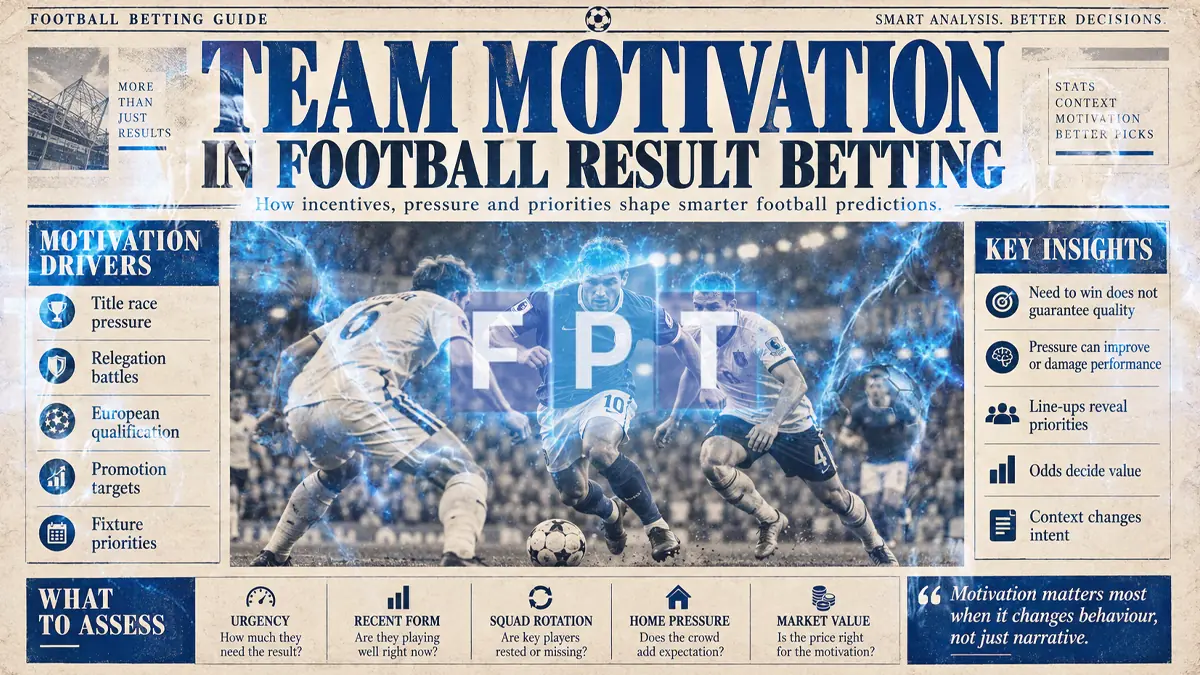
Team motivation can improve football result analysis when it is treated as a contextual factor rather than a shortcut. The strongest signals appear when a clear competitive objective changes team selection, tactical risk, pressing intensity or late-match behaviour. Title races, relegation battles, promotion campaigns and European qualification can all create these conditions, but each situation needs to be evaluated individually.
Bettors should combine motivational information with recent form, squad quality, expected line-ups, home and away performance, tactical matchups and fixture priorities. They should also consider whether pressure might reduce performance rather than improve it. Most importantly, any motivational advantage must be compared with the odds.
Football matches are not won simply by the team that needs the points more. Ability, tactics, execution and randomness remain crucial. Motivation becomes useful when it helps explain how a team is likely to behave and whether that behaviour changes the probability of the final result. By treating competitive incentives with proper context rather than relying on simplistic narratives, bettors can build more realistic and disciplined football result predictions.