Smarter Win Draw Win Analysis for Football Betting Decisions
Full-time result predictions are among the most traditional and widely followed areas of football betting. The market is simple on the surface: home win, draw, or away win. Because of that simplicity, many bettors see it as the most natural place to begin when analysing football matches. However, the full-time result market is also one of the most competitive betting markets because bookmakers, professional bettors, and casual players all pay close attention to it.
To make better full-time result predictions, bettors need to go beyond basic opinions about which team is stronger. A strong prediction is not built only on league position, recent wins, famous players, or public confidence. It requires a complete reading of form, odds, value, match context, tactical suitability, motivation, team news, and market movement. The best team on paper is not always the best bet, and the most likely result is not always worth backing if the odds are too short.
Professional football betting analysis is about asking better questions. Is the favourite priced correctly? Is the draw being underestimated? Has the market overreacted to recent form? Does the underdog have a tactical route to compete? Are injuries, rotation, fatigue, or motivation changing the real probability of the match? These are the details that turn a simple match prediction into a more informed betting decision.
Why Full-Time Result Betting Needs Careful Analysis
The full-time result market can feel easy because there are only three possible outcomes, but that does not make it simple to beat. Football is a low-scoring sport compared with many others, which means one mistake, one red card, one penalty, or one late goal can completely change the result. A team may dominate possession, create more chances, and still fail to win. This uncertainty is exactly why full-time result betting must be approached with discipline.
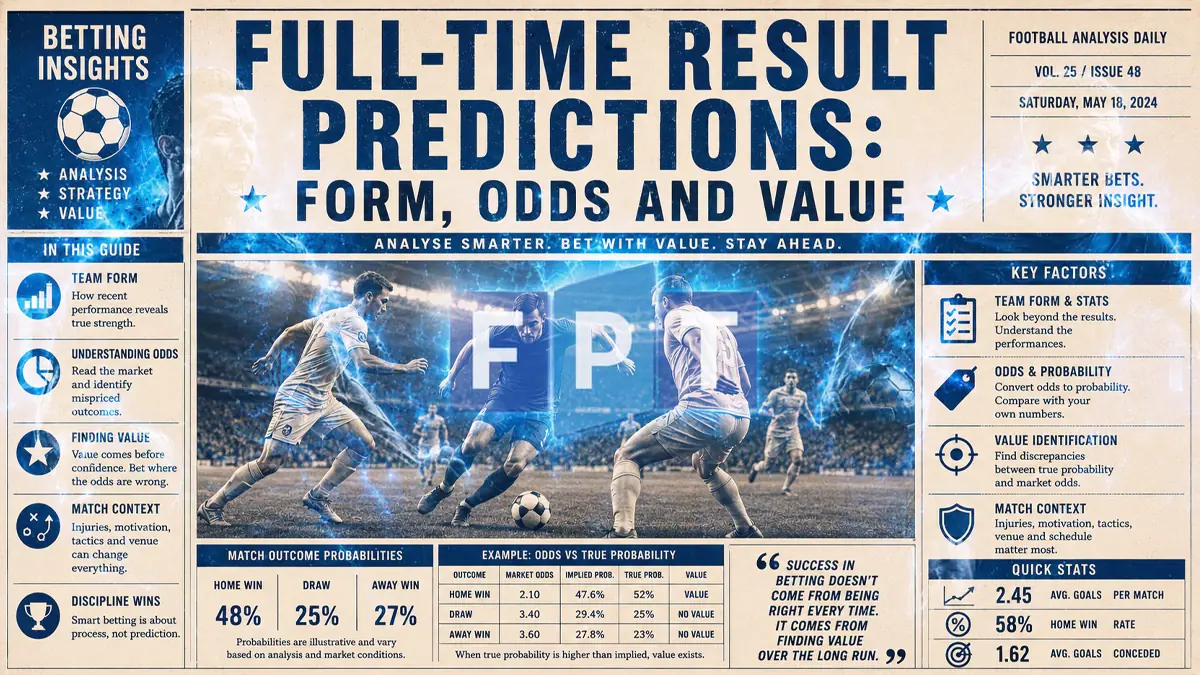
Many bettors make the mistake of treating the market as a question of who is better. In reality, the more important question is whether the odds correctly reflect the chance of each outcome. A favourite may have a high probability of winning but still be poor value if the price is too low. An underdog may have a lower probability of winning but still offer value if the odds are bigger than they should be.
The Winner Is Not Always the Best Bet
A common mistake in full-time result predictions is assuming that the strongest team should automatically be backed. In many cases, the strongest team will win, but betting is not only about being right. It is about being right at the right price. If a team has a realistic winning chance of around 60 percent but the odds suggest an even higher probability, the bet may not offer value.
This is why professional bettors separate football opinion from betting value. They may agree that a favourite is likely to win but still refuse to back it because the price is too short. Long-term betting decisions must be judged by probability and value, not only by whether the selection feels safe.
Understanding Team Form Properly
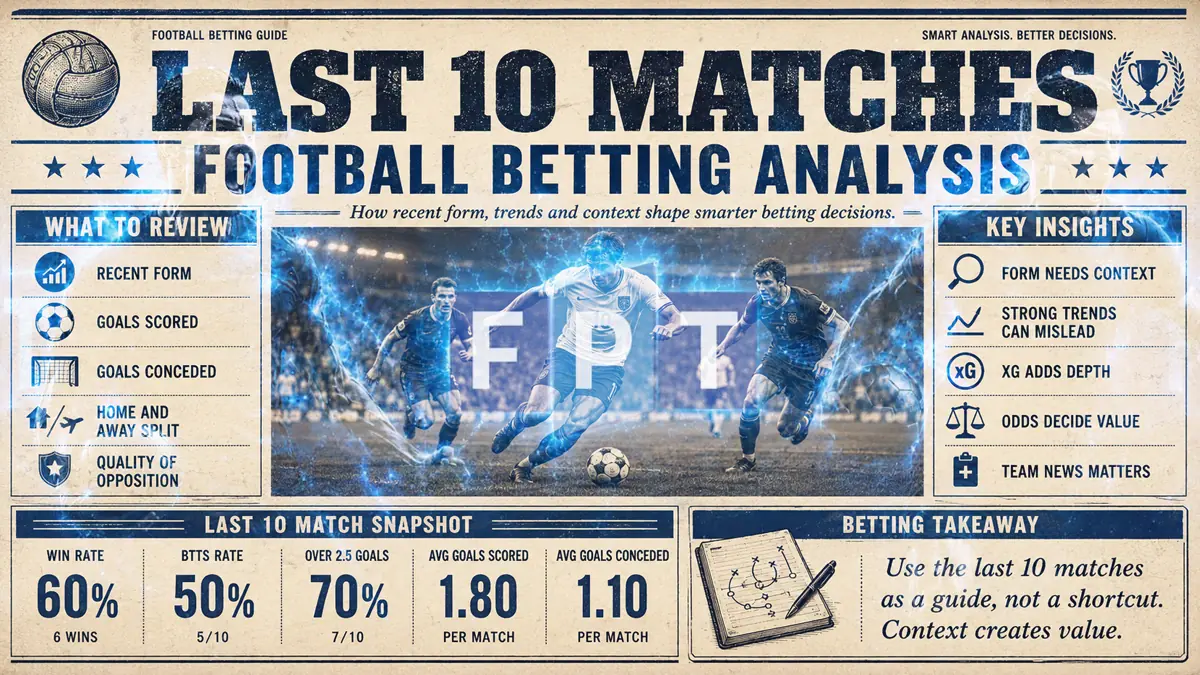
Form is one of the first things bettors look at when making full-time result predictions. Recent results can provide useful information about confidence, rhythm, momentum, and team performance. However, form can also be misleading when it is analysed too quickly. A winning run does not always mean a team is playing well, and a losing run does not always mean a team is performing badly.
To understand form properly, bettors need to study the quality of the opposition, the location of the matches, the performance level, and the underlying numbers behind the results. A team may have won several matches against weak opponents, while another may have lost narrowly against stronger sides despite producing competitive performances. The scoreline alone rarely tells the full story.
Recent Results Need Context
A team that has won four of its last five matches will often attract attention in the betting market. But those victories need to be questioned. Were they deserved? Did the team create enough chances? Was the defence solid, or did the goalkeeper make several important saves? Were the opponents missing key players? Did the team benefit from penalties, red cards, or late mistakes?
The same applies to poor form. A side that has lost several matches may still be improving if its performances are stronger than the results suggest. Expected goals, shot quality, pressing intensity, defensive structure, and chance creation can all reveal signs that a team is better or worse than its recent results indicate.
Home and Away Performance
Home and away form is essential in full-time result betting. Some teams are extremely strong at home but much weaker away. Others are comfortable on the road because they defend deep, counter-attack well, and perform better when the opponent takes more possession. Treating a team the same in every venue is a major analytical mistake.
A strong home side may press higher, attack with more numbers, and benefit from crowd support. An away side may become more cautious, especially if a draw would be a good result. These behavioural changes can influence the probability of all three outcomes: home win, draw, and away win.
Venue Can Change the Match Dynamic
Venue does not only affect confidence. It can also affect tactical choices. A home team may feel pressure to dominate, which can create attacking opportunities but also defensive spaces. An away team may be more comfortable playing without the ball and waiting for transition moments. In some fixtures, the underdog is more dangerous away because the match naturally creates counter-attacking conditions.
When analysing the full-time result market, bettors should always compare home records, away records, goals scored, goals conceded, clean sheets, and the level of opposition faced in each setting. This helps avoid overrating a team based on general form that may not apply to the specific venue.
Reading the Odds and Finding Value
Odds are not just numbers. They represent implied probability. Every full-time result price tells bettors how likely the market believes an outcome is. To make better predictions, bettors must understand whether those implied probabilities are accurate, too high, or too low.
If a home win is priced very short, the market is saying that the home team is highly likely to win. That may be true, but the bettor still needs to decide whether the real chance is even higher than the price suggests. If not, the bet may be poor value. On the other hand, a draw or away win may look unlikely but still be attractive if the price is too generous.
Value Comes Before Confidence
Many bettors confuse confidence with value. They prefer selections that feel likely, even when the odds are unattractive. This often leads to backing short-priced favourites with limited upside and significant risk. Football is unpredictable enough that low odds must be treated carefully.
A value-based approach does not mean always backing outsiders. It means comparing the available price with the true probability of the result. Sometimes value is on the favourite. Sometimes it is on the draw. Sometimes it is on the underdog. The professional approach is flexible and guided by price, not reputation.
The Draw Is Often Underestimated
The draw is one of the most important outcomes in full-time result betting, yet many bettors ignore it. They focus only on which team is better and forget that football matches frequently finish level, especially when the teams are evenly matched or when tactical caution is likely.
A draw can be particularly relevant in derby matches, lower-scoring leagues, first-leg knockout ties, relegation battles, or fixtures where both teams would accept a point. If neither side has a strong reason to take big risks, the draw becomes a serious possibility. Ignoring it can make straight win bets more dangerous than they appear.
When Draw No Bet Makes More Sense
There are situations where a bettor may believe one team is stronger but still worry about the draw. In those cases, Draw No Bet can sometimes be a more suitable market than the full-time result. The price will be lower, but the stake is protected if the match finishes level.
This does not mean Draw No Bet is always the better option. It depends on price and probability. However, professional bettors understand when the straight win market carries unnecessary risk and when alternative markets offer a better balance between confidence and value.
Team News, Motivation and Match Context
Team news can dramatically affect full-time result predictions. Injuries, suspensions, rotation, and late line-up changes can reduce a team winning probability. A missing striker may weaken finishing quality. A suspended defender may expose the back line. A midfield absence may reduce control and defensive protection.
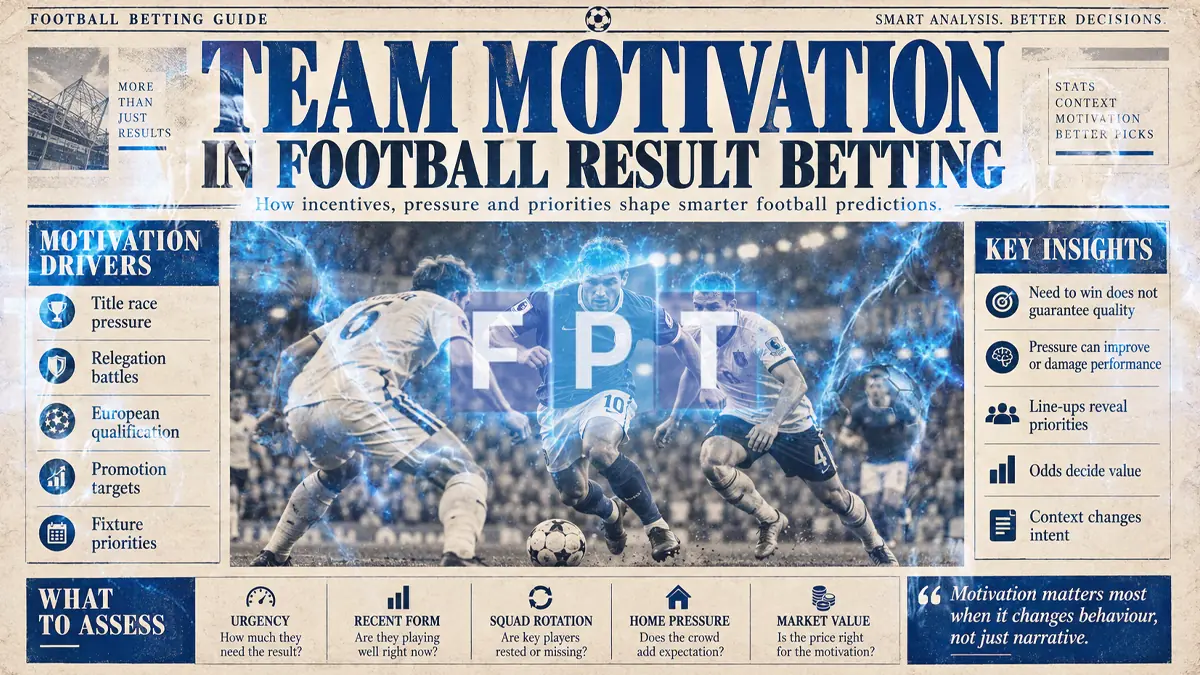
Motivation is just as important. A team fighting for survival may show more urgency than a comfortable mid-table side. A club chasing a title, promotion, or European qualification may approach the match with greater intensity. Meanwhile, a side with an important cup or European fixture coming up may rotate players or manage energy levels.
Not Every Match Means the Same to Both Teams
One of the biggest advantages in football analysis comes from understanding what each team needs. If one team must win and the other would accept a draw, the late-game dynamic can become very important. A team chasing victory may push forward and create chances, but it may also leave space behind.
Match context helps bettors predict behaviour, not just ability. A more talented team with limited motivation may be less reliable than a slightly weaker team with a clear objective. This is especially important near the end of the season, when league position does not always reflect current urgency.
Tactical Matchups in Full-Time Result Predictions
Football results are often shaped by tactical compatibility. A team may be strong overall but struggle against a specific style. For example, a possession-heavy side may find it difficult to break down a compact low block. A high-pressing team may dominate opponents that build slowly from the back but become vulnerable against direct counter-attacking sides.
Analysing tactical matchups helps bettors understand how the match may actually be played. The favourite may control possession but not create clear chances. The underdog may defend deep but have strong set-piece threat. A draw may become more likely if both teams cancel each other out. These details are essential in full-time result betting.
Set Pieces and Transitions Can Decide Results
Set pieces and transitions are often decisive in close matches. A team with strong corner delivery, aerial power, or free-kick quality may have a route to goal even when it creates little from open play. Similarly, a team with fast forwards can threaten opponents that leave space behind.
These factors are especially important when evaluating underdogs. A weaker team does not need to dominate the match to win or draw. It only needs a realistic path to create danger. Professional full-time result predictions always consider how each team can score, defend, and manage key phases of the game.
A More Professional Way to Predict Match Outcomes
Better full-time result predictions come from combining form, odds, and value with real football context. Bettors should not rely only on recent results, league position, or team reputation. They should analyse home and away performance, team news, motivation, tactical matchups, market price, and the realistic probability of each outcome.
The full-time result market will always remain popular because it is simple and familiar, but that familiarity can create overconfidence. To improve, bettors must become more selective. Not every match needs a bet, and not every favourite deserves support. Sometimes the best decision is to avoid the market, wait for team news, or choose a different betting angle.
In the long run, successful full-time result betting is not about guessing winners. It is about understanding probability, respecting risk, and finding value where the market may be slightly wrong. When form, odds, and context are analysed together, bettors can make smarter decisions and build a more disciplined approach to football prediction.